

Prioritize with Purpose: Using the Eisenhower Matrix to Manage Time and Boost Productivity

The Eisenhower Matrix is a simple, four-quadrant system that separates tasks by urgency and importance so you can reduce overwhelm and direct your attention where it matters most. Sort work into Do, Schedule, Delegate, and Delete categories to externalize decisions, lower cognitive load, and free up capacity for high-value efforts. This guide gives you clear classification rules, a step-by-step way to use the matrix day-to-day, and practical psychological strategies to beat resistance and decision fatigue. You’ll learn to tell urgent from important, protect Quadrant 2 time with time‑blocking and delegation, and adapt the method for high-achieving individuals and leaders. We also address common barriers—procrastination, perfectionism, ADHD-related executive challenges, and anxiety—and explain how targeted coaching strengthens executive function and supports lasting change. Finally, you’ll find complementary time-management techniques, anonymized coaching outcomes, and straightforward next steps if you want personalized prioritization support.
What the Eisenhower Matrix Is — and Why It Changes How You Work
The Eisenhower Matrix divides tasks into four quadrants using two simple dimensions: urgency and importance. Making those decision rules explicit—urgent items need immediate action; important ones advance meaningful goals—moves people out of reactive mode and into more strategic planning. When you externalize choices with a visual framework, you reduce mental clutter and preserve working memory for complex thinking. Teams and individuals who adopt this tool shift from constant triage to deliberate scheduling, which lowers stress and yields measurable gains in focus and productivity. Knowing the matrix’s origins and its practical quadrants helps you use it intentionally in daily and weekly planning.
Origins and Popularization: Eisenhower to Stephen Covey
The core idea goes back to Dwight D. Eisenhower, who used urgency and importance to prioritize high‑stakes decisions. Stephen Covey later translated that heuristic into a time‑management context and popularized it for readers, emphasizing Quadrant 2—important but not urgent— as the strategic space for growth. Covey framed the matrix within habit formation and planning to prevent crises rather than react to them. That lineage shows how a practical decision rule from leadership can become a reliable productivity method for professionals, connecting long‑range strategy to everyday task choices.
Eisenhower Box: Practical Thinking About Urgency, Importance, and Time Spot urgency when decisions are driven by short‑term pressure; spot importance when tasks align with your mission, values, and goals. Email often looks like a unique time drain, but it’s typically a symptom of not having a clear decision framework. Frameworks like the Eisenhower Box help you apply consistent rules so time management is less about tricks and more about practiced habits, good organization, and clear communication with colleagues. Commitment to these practices can meaningfully change how you use your time. Read past issues
The Four Quadrants — What They Mean and How to Act
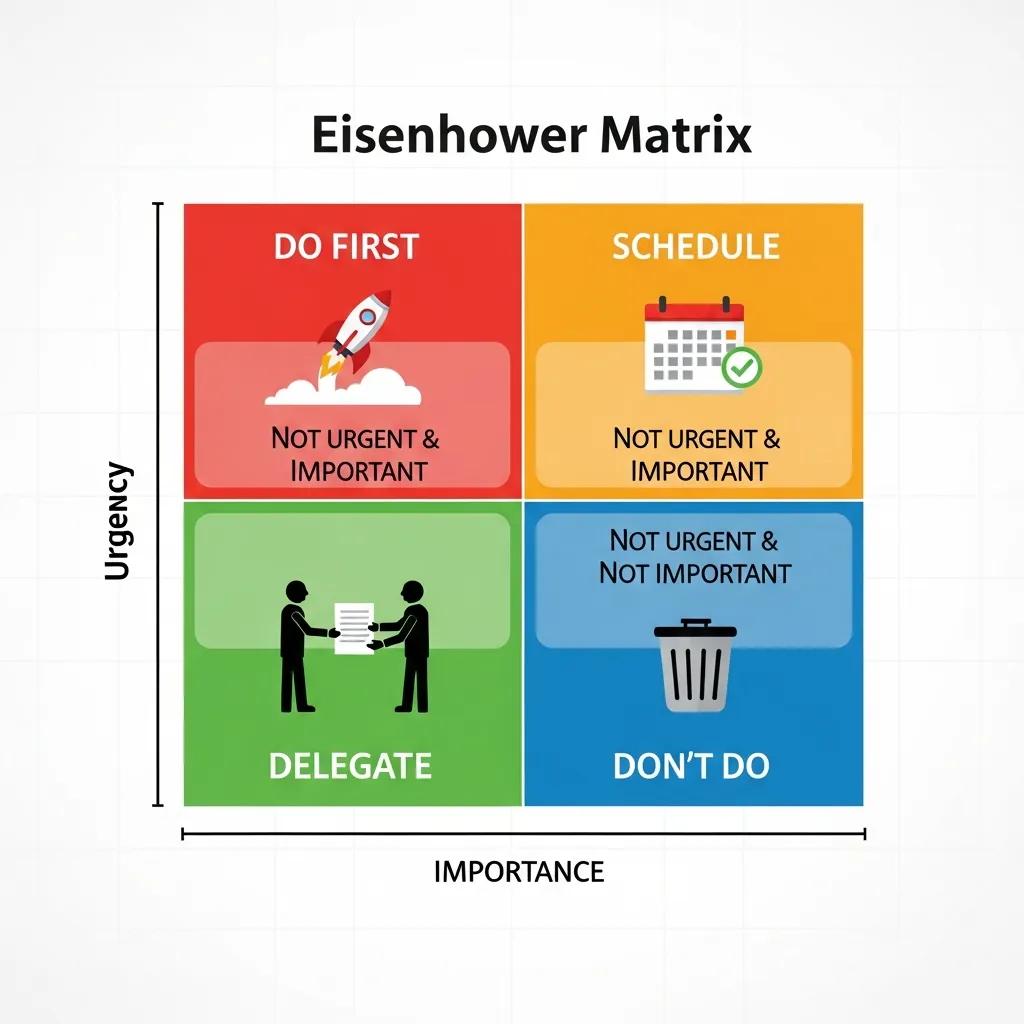
Each quadrant prescribes a different response, creating predictable behaviors: handle emergencies now, schedule strategic work, delegate interruptions, and remove low‑value tasks. That clarity helps maintain focus on long‑term objectives. The table below pairs each quadrant with recommended actions and concrete examples so you can put the matrix into practice immediately.
Intro to the quadrant comparison table: The following table maps each quadrant to its primary action and example tasks so you can quickly identify where common activities belong.
| Quadrant | Recommended Action | When to Use / Example Task |
|---|---|---|
| Quadrant 1 (Urgent & Important) | Act now | Critical client deadline; acute health or safety concerns |
| Quadrant 2 (Important, Not Urgent) | Schedule / Time‑block | Strategic planning, professional development, relationship maintenance |
| Quadrant 3 (Urgent, Not Important) | Delegate | Interruptions, routine requests, administrative approvals |
| Quadrant 4 (Not Urgent, Not Important) | Delete / Minimize | Excessive social media, low‑value busywork, repetitive distractions |
This concise Quadrant → Action → Example table gives you anchors for consistent prioritization decisions so the matrix is easier to apply in daily planning.
How to Tell Urgent from Important — Practical Rules
Clear definitions and a few decision heuristics keep emotion and reactivity from driving your choices. Urgent tasks demand immediate attention because of deadlines or time sensitivity; important tasks move long‑term goals forward or reflect core values. A useful question: “Will this task meaningfully advance my key goals in the next quarter?” If yes and there’s no immediate deadline, it’s likely important but not urgent. Teach your calendar and team to flag deadlines separately from strategic impact to reduce urgency bias and protect Quadrant 2 time. These classification rules also prepare you to address psychological biases that can skew judgment, which we cover next.
Urgency vs. Importance — Why the Distinction Matters
Urgency is about time pressure; importance is about long‑term value and alignment with goals. Urgent items trigger stress responses that can make them seem more consequential than they are, while important work usually requires planning and sustained attention. For example, a quick client email can feel urgent but scheduling a quarterly strategy session is important. Conflating the two leads to imbalance. Making this distinction helps you allocate cognitive resources deliberately and supports healthier work rhythms.
Perception and Bias: How Feelings Shape Categorization
Perception affects categorization through cognitive biases—negativity bias, salience, and FOMO—that make urgent signals feel disproportionately important. Fatigue and decision depletion amplify those signals, causing many high‑achievers to overemphasize Quadrants 1 and 3. Structured decision rules and coaching interventions counter these biases by externalizing choices (checklists, pre‑commitments) and clarifying delegation criteria. Because perception drives behavior, correcting these distortions is essential before procedural changes will stick; that’s why psychological strategies are part of sustainable prioritization.
Turning the Matrix into Daily Practice: A Simple Workflow
The matrix becomes useful when paired with a reproducible workflow: capture tasks, classify them by urgency and importance, act according to quadrant rules, and review outcomes regularly. This process reduces cognitive load by turning many small decisions into a few repeatable actions, which speeds execution and increases consistency. Best practices include a daily capture habit, weekly scheduling for Quadrant 2, delegation protocols for Quadrant 3, and regular pruning of Quadrant 4 tasks. Simple four‑quadrant templates, calendar time‑blocks, and delegation checklists make adoption practical for individuals and teams. These operational habits let you adapt the matrix for leadership roles and high‑performance contexts while tracking measurable improvement.
A clear, stepwise process reduces time spent wondering what to do next.
- Capture: Collect all tasks into a single inbox so nothing fragments your attention.
- Classify: Use your urgency/importance rules and spend 10–15 minutes weekly assigning quadrants.
- Act: Do Quadrant 1 tasks now, schedule Quadrant 2 into your calendar, delegate Quadrant 3, and remove Quadrant 4.
- Review: Run a weekly review to reassign tasks and refine delegation flows.
Repeat this capture→classify→act→review loop to reduce decision fatigue and make Quadrant 2 work the default instead of the exception.
Intro to the techniques comparison table: The next table contrasts practical techniques you can pair with the matrix and coaching tips that boost their effectiveness.
| Technique | Use-case | Benefit / Coaching Tip |
|---|---|---|
| Time‑blocking | Protects Quadrant 2 work | Creates committed focus periods; coaches recommend ritualized start/end cues |
| Delegation protocol | Offloads Quadrant 3 tasks | Standardizes handoffs and accountability to trusted teammates |
| Pomodoro batching | Deep work for intensive tasks | Maintains momentum, reduces task switching; useful to begin Quadrant 2 work |
| Weekly triage | Classifies backlog efficiently | Structured review lowers anxiety and clarifies next actions |
Pairing these techniques with coaching guidance magnifies the matrix’s effect and makes prioritization sustainable.
Practical note about coaching support: For many high‑achieving professionals, a short coaching series accelerates adoption and cements the planning habits needed to protect Quadrant 2 time. Dr. Lena Agree, JD, PsyD and Associates offers tailored coaching that aligns with your prioritization goals, using attachment‑ and mentalization‑informed approaches to grow internal resilience and flexibility. If you’re considering integrating coaching into your prioritization practice, a consultation can clarify fit and next steps.
Psychological Barriers — What Gets in the Way and How Coaching Helps

Common psychological barriers distort prioritization: procrastination from fear of failure, perfectionism that inflates task scope, ADHD‑related executive challenges that impair initiation and working memory, generalized anxiety that amplifies urgency, and decision fatigue that undermines judgment. These mechanisms produce predictable behaviors—avoidance, over‑polishing, impulsive responding—that erode sustained Quadrant 2 activity. Coaching addresses these patterns by externalizing decisions, scaffolding goals, and building accountability structures that reduce cognitive load and improve task initiation. Supporting mental well‑being—sleep, boundaries, and stress reduction—reinforces executive control and sustains behavioral change over time.
Intro to the barriers table: The following table maps common barriers to their psychological mechanisms and coaching strategies that produce measurable outcomes.
| Barrier | Psychological mechanism | Coaching strategy / Outcome |
|---|---|---|
| Perfectionism | Fear of negative evaluation; inflated standards | Graded exposure and acceptance‑focused goals; less time lost to low‑value refining |
| Procrastination | Avoidance of aversive tasks | Task scaffolding, Pomodoro starts, accountability checks; increases initiation |
| ADHD / Executive dysfunction | Working memory limits and switching costs | External structures, visual timers, prioritized lists; improves completion consistency |
| Decision fatigue | Cognitive depletion from repeated choices | Pre‑commitment rules and templates; lowers daily decision load |
Mapping barriers to targeted coaching strategies clarifies which interventions will move the needle fastest and why integrating mental‑health‑aware practices improves prioritization capacity.
How Coaching Strengthens Executive Function and Reduces Decision Fatigue
Coaching translates internal choices into external systems—checklists, prioritized templates, and committed calendar blocks—that lower working memory demands and conserve self‑control. Coaches break tasks into bite‑sized steps, establish regular review cadences, and provide accountability that converts intention into action. These supports blunt decision fatigue by introducing pre‑defined rules for common scenarios and by delegating low‑value choices to reliable processes or team members. The result: clearer thinking and more cognitive bandwidth for strategic Quadrant 2 work.
Mental Well‑being as the Foundation of Effective Time Management
Your sleep, stress level, and mood shape working memory, impulse control, and how you perceive urgency. Poor sleep narrows cognitive flexibility, high stress biases attention toward immediate threats, and untreated mood issues can sap motivation for long‑term planning. Coaches weave in mental‑health‑oriented practices—sleep hygiene, boundary work, brief stress reduction—to restore executive capacity and make prioritization sustainable. For high performance, well‑being is not optional; it’s the foundation that lets structured methods like the Eisenhower Matrix reliably deliver results.
Time‑Management Techniques That Complement the Matrix
The matrix pairs well with time‑blocking, Pomodoro intervals, task batching, SMART goals, and OKR alignment to make Quadrant 2 work visible and actionable. Each method targets a different bottleneck: time‑blocking protects focus, Pomodoro eases initiation, batching reduces context switching, and SMART/OKRs ensure daily tasks ladder up to strategic aims. Folding these techniques into a weekly planning rhythm creates consistent space for Quadrant 2 work instead of letting it be crowded out. A compact toolkit and a weekly review deliver measurable stress reduction and greater job satisfaction.
The next bullet list summarizes complementary techniques and when to use them.
- Time‑blocking: Reserve calendar space for Quadrant 2 projects so deep work actually happens.
- Pomodoro Technique: Use focused intervals to overcome start‑up friction and sustain attention.
- Task batching: Group similar administrative tasks to cut down context switching and protect larger blocks for deep work.
Used together, these methods turn prioritization from a good intention into repeatable behavior.
How Strategic Prioritization Protects Against Burnout and Improves Satisfaction
Strategic prioritization reduces burnout by aligning daily work with core values and by stopping chronic overcommitment to reactive tasks. Moving from constant crisis management to planned, value‑driven work increases perceived control and job satisfaction. Trackable metrics—weekly hours on Quadrant 2, frequency of crisis incidents, and self‑reported stress—make improvements visible and reinforce positive change. Regular review cadences and boundary rules help preserve gains and prevent slipping back into reactive patterns.
Goal‑Setting and Planning Methods That Make the Matrix Work
SMART goals and OKRs translate strategic priorities into milestones that populate Quadrant 2 and guide scheduling. Weekly planning sessions that map tasks to outcomes, together with monthly metric reviews, keep long‑term objectives actionable. A short template linking each Quadrant 2 item to a measurable SMART objective and a next action reduces ambiguity and increases follow‑through. When planning methods explicitly connect to the matrix, Quadrant 2 work becomes the engine of your weekly schedule and resource allocation.
Embedding the Matrix in Coaching for Ongoing Change
Coaches incorporate the Eisenhower Matrix into modular programs that start with assessment, move through skills coaching, and end with accountability structures that make prioritization habitual. Typical protocol: an initial audit of time use and psychological barriers, a customized matrix and delegation plan, instruction in practical techniques (time‑blocking, batching), and scheduled accountability check‑ins to measure outcomes. This stepwise integration builds competence and confidence, producing measurable results such as reclaimed hours, lower stress, and stronger alignment with strategic goals. The anonymized examples below illustrate those real‑world impacts without identifying clients.
Examples: What Success Looks Like with Coaching + the Matrix
Real client vignettes show typical outcomes: a business owner reduced weekly reactive hours by delegating Quadrant 3 tasks and reclaimed time for strategic planning; an executive recovered four hours per week by scheduling Quadrant 2 deep work with time‑blocking rituals; and a professional with ADHD improved initiation using externalized checklists and Pomodoro starts. Each case followed the same arc: assessment revealed misclassification and overload, coaching introduced external systems and accountability, and outcomes were tracked with weekly logs. Together, these examples show that coaching plus the matrix produces concrete improvements in time use, stress, and perceived control.
How to Book a Prioritization Consultation
Booking a prioritization consultation begins with a short intake to clarify your goals, current obstacles, and readiness for change. Expect an assessment of time use and psychological barriers and a proposed coaching plan tailored to your needs. Dr. Lena Agree, JD, PsyD and Associates provide concierge‑style psychology and coaching for high‑achieving individuals, business owners, and families, using attachment‑ and mentalization‑based methods to strengthen internal resources. In an initial consultation you’ll review an intake, co‑create measurable goals, and discuss an appropriate cadence of sessions to build sustainable prioritization skills. If you’re ready to move beyond rigid patterns and increase functional courage, a consultation is the practical next step.
Frequently Asked Questions
How can I effectively implement the Eisenhower Matrix in my daily routine?
Start by capturing everything in a single inbox, then classify tasks into the four quadrants using your urgency/importance rules. Block time in your calendar for Quadrant 2 work so it isn’t crowded out, and run a short weekly review to reclassify tasks and adjust plans. This predictable rhythm reduces decision fatigue and makes focusing on high‑value work a habit.
What are some common mistakes people make when using the Eisenhower Matrix?
Common errors include misclassifying tasks (treating urgent but low‑value items as important), ignoring Quadrant 2 work, and skipping regular reviews. To avoid these pitfalls, define urgency and importance clearly for your context and commit to a weekly review to keep priorities aligned with your goals.
Can the Eisenhower Matrix be adapted for team use in a workplace setting?
Absolutely. Teams can co‑create quadrant definitions during planning sessions and use shared tools to visualize tasks in the matrix. Regular check‑ins maintain alignment and accountability, helping the team focus on the most impactful work rather than getting pulled into constant triage.
How does the Eisenhower Matrix help in reducing stress and preventing burnout?
The matrix reduces stress by helping you prioritize tasks that matter and avoid chronic reactivity. When you consistently protect Quadrant 2 time, you shift from firefighting to planned, value‑driven work—this increases control and satisfaction and lowers the risk of burnout.
What role does accountability play in using the Eisenhower Matrix effectively?
Accountability is key. Sharing commitments with a coach, mentor, or team increases follow‑through and helps overcome barriers to initiation. Regular check‑ins keep Quadrant 2 work visible and reinforce the habits that sustain prioritization over time.
How can I measure the effectiveness of using the Eisenhower Matrix?
Track metrics such as hours spent on Quadrant 2 work, frequency of crisis incidents, task completion rates, and self‑reported stress. Weekly reflections and simple logs make progress visible and help you tune the system to what actually moves the needle.
Conclusion
The Eisenhower Matrix is a practical tool for moving from reactive busyness to intentional, values‑aligned work. By distinguishing urgent from important and pairing the matrix with coaching and supportive techniques, you can protect strategic time, reduce stress, and create measurable gains in productivity and satisfaction. If you want help making these changes stick, consider exploring personalized coaching options to build sustainable prioritization habits.