
• Skip to main content
  • Skip to footer

Dr. Lena Agree, JD, PsyD logo featuring elegant script and professional title, representing the Agree Psychology Team's focus on mental health and personal growth.Dr. Lena Agree, JD, PsyD – Licensed Psychologist and Associates

  • (248) 219-2548
  • Dr. Agree
    • Meet Dr. Agree
    • Concierge Model
  • Therapists
    • Overview
    • Aleena Hellebuyck
    • Jodi Leib Coden
  • Services
    • Individual Therapy
    • Couples Therapy
    • Child and Teen Therapy
    • Group Therapy
    • Coaching
    • Parenting Support
    • Personality Assessment
  • Working Together
    • Therapeutic Approach
    • Experience
      • Identity
      • Freedom
      • Self-Esteem
      • Peace
      • Relief
    • Your First Visit
    • Rates and Insurance
  • Resources
    • Suggested Resources
    • Blog
    • HIPAA Privacy Policy
    • FAQ’s
    • Opportunities
  • Contact Us
Young woman gazing into a mirror reflecting an ethereal version of herself, symbolizing self-discovery and transformation, with a vibrant cosmic background.

How to Change into the Person You Wish You Were

October 6, 2025 By Jodi Coden, MA, Registered Drama Therapist

Written by Jodi Leib Coden, MA

Young woman gazing into a mirror reflecting an ethereal version of herself, symbolizing self-discovery and transformation, with a vibrant cosmic background.

When you envision your life five, 10, or even 25 years into the future – who’s standing there waiting for you?

Most of us immediately picture others: a loving partner, playful children, colleagues and friends, and maybe even a loyal pet. You may imagine achievements such as winning an award, having a happy and healthy marriage, or building your dream house. But the most powerful aspect of that vision isn’t what’s around you –it’swho you’re becoming.

Not just a richer or more successful you, but a wiser, more grounded, more fully embodied version of yourself. The you who’s walked through the chaos of today and emerged on the other side – radiant, resilient, and real.

What if you didn’t have to wait decades to meet that future version of you? What if you could rehearse your way into your future self – startingright now?

Drama therapy isn’t about becoming an actor – it’s a transformative tool for self-development that empowers you to envision, rehearse, and embody your ideal self, harnessing the power of imagination, neuroscience, and somatic expression.


Why Drama Therapy Works

Drama therapy is an experiential, creative form of psychotherapy that draws on techniques such as improvisation, role-playing, projection, storytelling, and embodied expression to foster personal growth and transformation. When applied to future self-work, it activates three core psychological processes:

Visualization

When you see your future self in vivid detail, you activate parts of your brain linked to emotional regulation, goal-setting, and sensory processing. Your imagination brings possibility into the present moment, setting an intention filled with positive emotions.
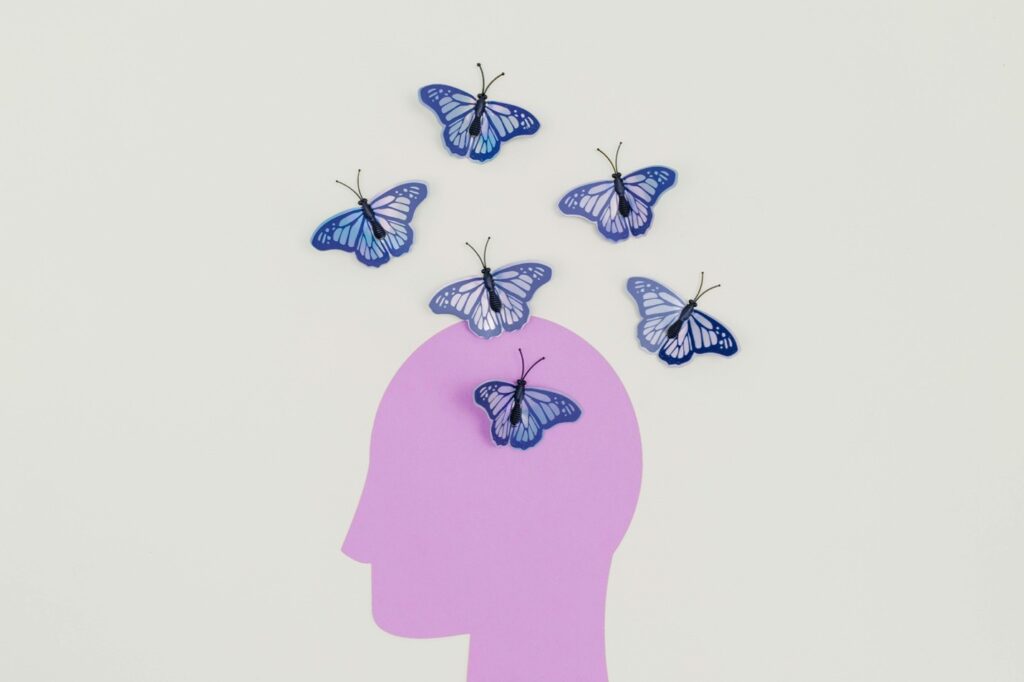
Purple silhouette of a human head with blue butterflies, symbolizing imagination and transformation in drama therapy and personal growth.

Neuroplasticity

Your brain is highly adaptable. When you create new mental images and beliefs about your future, you literally rewire your brain to accept it as reality. Through self-reflection and future-oriented projection, you’re not just daydreaming; you’re forming new neural pathways, priming your brain for new behaviors and desired outcomes.

New pathways = new possibilities.

Behavioral Rehearsal

When you move like your future self, your body starts to believe it. By physically acting out your future self’s movements, emotions, and responses, you begin to feel confident and courageous, developing muscle memory for success. The more you feel at home in this new identity, the less likely you are to reject it due to fear or unfamiliarity.

You’re not just “acting” – You’re architecting a new internal blueprint.

Open door framing a view of a serene landscape with a beach and distant islands, symbolizing new possibilities and personal transformation through self-reflection and future-oriented projection.

Guided Practice: How to Meet Your Future Self (No Time Machine Required)

Set aside about 30–45 minutes for this self-guided practice. You’ll need a quiet space, a journal or piece of paper, and some colored pencils, markers, or crayons.

Step 1: Ground Yourself in the Present Moment

  • Start by relaxing your body. Take a few deep breaths. Close your eyes and let your breath gradually ease tension from every muscle in your body.
  • Focus on your breath until your mind becomes still.

Step 2: Visualize Your Future Self

Picture yourself in the future: think 1 year, 10 years, or even 50 years ahead.

  • How old are you?
    • What does life look like?
    • Who’s around you?
    • What’s the vibe?

This isn’t about realism – it’s about resonance. Let your imagination flow.

Step 3: Engage the Senses

Bring the scene to life by tapping into your sensory memory:

  • Sight – What do you see? How do you look? What’s in the environment?
  • Sound – Is there music? Laughter? Silence?
  • Smell – Fresh coffee? Ocean breeze? New book smell?
  • Touch – Bare feet in the sand? A warm hug?
  • Taste – Celebration cake? Spicy noodles? Something decadent?

The salient the detail, the stronger the imprint.

Step 4: Explore Emotions

  • How are you feeling emotionally at this moment? Joy? Serenity? Gratitude? Maybe even a little fear? If so, that’s normal! Change takes courage… but remember, this is a rehearsal… there’s no harm in trying!

Step 5: Create Your Timeline in Three Self-Portraits

Get your art supplies and draw three reflective self-portraits:

  1. Your Past Self – Who were you before becoming who you are now?
  2. Your Present Self – What represents you in this current stage of life?
  3. Your Future Self – Inspired by your visualization, draw the future you. Don’t worry about artistic skill – think metaphor, emotion, energy. Capture the essence, recognizing how far you’ve come.

Mountain landscape with dramatic cliffs and a glowing red light trail, symbolizing transformation and movement, reflecting themes of personal evolution and self-discovery in drama therapy.

Step 6: Embody Your Evolving Self

Now it’s time to embody these versions of you and bring them to life.

  1. Embody Your Past Self – Using movement, posture, and expression, act out how you felt in that stage of life. Were you scared, confident, naïve? Were your shoulders hunched? Arms crossed? Eyes cast up or down?
  2. Embody Your Present Self – What does the now-you feel? How do you express this in your body? Are you more open? Curious? Tentative? If someone saw you frozen in this pose, could they guess what you’re going through?
  3. Embody Your Future Self – Now, step into your future’s shoes. Literally. How do you move? Walk? Do you stand tall? Smile? How does success, wisdom, and fulfillment look and feel in your body? Let your body be a vessel for who you are becoming.

Integrate: Make It Real

You’ve now seen, felt, drawn, and embodied your future self. It’s no longer just an abstract concept – who you are becoming is familiar.

For the next 5 minutes –

  • Walk and move like your future self
  • Speak out loud (or in your mind) as if it were really happening in this moment
  • Think as your wise self with the knowledge of all your life experiences

And when faced with a challenge, ask yourself:

What would my future self want me to do right now?

If she’s a doctor, start preparing for the MCAT
If he’s a Broadway performer, book that voice lesson
If they’re financially free, meet with an advisor to create a long-term investment strategy


You Already Are Your Future Self – You Just Haven’t Caught Up Yet

Your future self isn’t a stranger. You’re made up of the choices you make today. And with tools like drama therapy, you don’t have to wait to meet you. You can rehearse your way into your next chapter – thoughtfully, creatively, and powerfully.

So go ahead. Start rehearsing. Step into your role of a lifetime!

Jodi Leib Coden, MA has a master of arts in drama therapy and psychological therapy, a Registered Drama Therapist and doctoral candidate in clinical psychology. She treats children and adults of all ages, in both individual and group therapy. 

Inquire about scheduling an appointment with Jodi.

Written by Jodi Coden, MA, Registered Drama Therapist· Categorized: Resources, Therapy· Tagged: behavioral rehearsal, creative healing, creative therapy, drama therapy, emotional wellness, expressive arts therapy, future self, future self exercise, guided visualization, mind body connection, personal growth, psychotherapy, self development, self transformation, somatic healing, therapy, visualization

About Jodi Coden, MA, Registered Drama Therapist

  • Return to Blog
  • Next >

Explore Drama Therapy Services, Resources & Contact Info

Services

  • Individual Therapy
  • Couples Therapy
  • Group Therapy
  • Child and Teen Therapy
  • Coaching
  • Parenting Support
  • Personality Assessment

About

  • Meet Dr. Agree
  • Concierge Model

Therapists

  • Overview
  • Aleena Hellebuyck
  • Jessica Guobis
  • Jodi Leib Coden

Working Together

  • Therapeutic Approach
  • Identity
  • Freedom
  • Self-Esteem
  • Peace
  • Relief
  • Your First Visit
  • Rates and Insurance

Resources

  • Suggested Resources
  • Blog
  • HIPAA Privacy Policy
  • FAQ's

Contact

(248) 219-2548

800 N. Old Woodward Ave. Ste 110 Birmingham, MI 48009

Hours: Monday-Sunday:
10:00 am - 8:30 pm

Valentine Digital Marketing

Let's Connect

© 2026 Lena Agree, JD, PsyD. | Privacy • Cookies • Terms • Disclaimer

Manage Consent
To provide the best experiences, we use technologies like cookies to store and/or access device information. Consenting to these technologies will allow us to process data such as browsing behavior or unique IDs on this site. Not consenting or withdrawing consent, may adversely affect certain features and functions.
Functional Always active
The technical storage or access is strictly necessary for the legitimate purpose of enabling the use of a specific service explicitly requested by the subscriber or user, or for the sole purpose of carrying out the transmission of a communication over an electronic communications network.
Preferences
The technical storage or access is necessary for the legitimate purpose of storing preferences that are not requested by the subscriber or user.
Statistics
The technical storage or access that is used exclusively for statistical purposes.The technical storage or access that is used exclusively for anonymous statistical purposes. Without a subpoena, voluntary compliance on the part of your Internet Service Provider, or additional records from a third party, information stored or retrieved for this purpose alone cannot usually be used to identify you.
Marketing
The technical storage or access is required to create user profiles to send advertising, or to track the user on a website or across several websites for similar marketing purposes.
  • Manage options
  • Manage services
  • Manage {vendor_count} vendors
  • Read more about these purposes
View preferences
  • {title}
  • {title}
  • {title}
Dr. Lena Agree, JD, PsyD logo featuring elegant script and professional title, representing the Agree Psychology Team's focus on mental health and personal growth.Logo Header Menu
  • Dr. Agree
    • Meet Dr. Agree
    • Concierge Model
  • Therapists
    • Overview
    • Aleena Hellebuyck
    • Jodi Leib Coden
  • Services
    • Individual Therapy
    • Couples Therapy
    • Child and Teen Therapy
    • Group Therapy
    • Coaching
    • Parenting Support
    • Personality Assessment
  • Working Together
    • Therapeutic Approach
    • Experience
      • Identity
      • Freedom
      • Self-Esteem
      • Peace
      • Relief
    • Your First Visit
    • Rates and Insurance
  • Resources
    • Suggested Resources
    • Blog
    • HIPAA Privacy Policy
    • FAQ’s
    • Opportunities
  • Contact Us

transformative self work, teen therapy hove

The Role of Visualization in Drama Therapy

Visualization is a cornerstone technique in drama therapy that allows individuals to create vivid mental images of their future selves. This process not only engages the imagination but also activates brain regions associated with emotional regulation and goal-setting. By envisioning their ideal future, clients can foster a sense of hope and motivation, bridging the gap between their current state and desired outcomes.

Research shows that effective visualization can lead to significant changes in behavior and mindset. For instance, athletes often use visualization techniques to improve performance, illustrating the power of mental imagery in achieving real-world success. In drama therapy, clients are encouraged to see their future selves in detail, enhancing their emotional connection to the goals they set, which can lead to transformative personal growth.

Techniques for Embodying Your Future Self

Embodying your future self involves physically acting out the characteristics, movements, and emotions of the person you aspire to become. This technique helps clients internalize their future identity, making it more tangible and achievable. By practicing specific gestures or postures associated with confidence and success, individuals can rewire their body’s responses and cultivate a sense of belonging to their future selves.

In drama therapy, this technique can be further enhanced through role-playing scenarios where clients explore different aspects of their future identity. For example, someone envisioning themselves as a leader might practice speaking and moving with authority. These embodied practices not only promote self-awareness but also reduce anxiety associated with change, making the transition to one’s ideal self feel more natural and attainable.

Integrating Creative Expression in Personal Growth

Creative expression is a vital component of drama therapy, as it encourages individuals to explore their emotions and experiences in a safe and imaginative way. Through activities such as drawing, storytelling, and improvisation, clients can articulate their feelings and aspirations, facilitating deeper self-understanding and growth. This form of expression allows for the exploration of complex emotions that may be difficult to verbalize.

For instance, clients might engage in art therapy by creating a visual representation of their future selves, which can serve as a powerful motivational tool. By integrating creative processes into their therapeutic journey, individuals can unlock new perspectives and insights, ultimately enhancing their ability to navigate personal transformations and achieve their goals.

Overcoming Barriers to Change with Drama Therapy

Drama therapy provides tools for individuals to confront and overcome the barriers that hinder personal transformation. Common obstacles include fear of failure, self-doubt, and ingrained habits. Through therapeutic techniques, clients can identify these barriers and work through them in a supportive environment, allowing for a more profound understanding of their limitations and potential.

For example, role-playing can help clients rehearse responses to challenging situations, building resilience and confidence. By practicing these scenarios, individuals learn to navigate their fears and develop strategies for coping with adversity. This proactive approach to overcoming barriers not only empowers clients but also reinforces their commitment to personal growth and transformation.